
Showing posts with label February. Show all posts
Showing posts with label February. Show all posts
Gearest Rain Gear Going - 1966
Friday, April 4, 2014
The Ladies' Home Journal in 1966 gave some groovy advice for your next raincoat!

Century - Old Fabrics
Sunday, March 30, 2014
In the February issue of Theatre Arts Monthly in 1929 we find an ad for Old Arts. G. O. Neddrie offering Century Old Fabrics.
"Embroideries, velvets, brocades and damasks of the the XV to XVIII Centuries from the looms and cloisters of France, Spain, Italy, Flanders and England in Gothic, Renaissance and the designs of the masters during XVII and XVIII Century. Fabrics that will lend warmth and color to any room in the inimitable shadings that only age can impart."
I thought this might have been aimed at stage set designers or for costumes. But then I read the next part and I think they were advertising to the upscale folks who were around the theatre.
"These fabrics are also ingeniously adapted to modern utilities: Book Ends, Picture Frames, Paper Baskets, Cigarette Boxes, Humidors, Cushions, Wall Hangings, Table Runners, Boudoir Boxes"
So now I am heart broken to think of how many priceless fabrics were made into Cigarette Boxes.
(I wasn't able to find out more about G. O. Niddrie, but it was a very prestigious address. Any of you know more?)

"Embroideries, velvets, brocades and damasks of the the XV to XVIII Centuries from the looms and cloisters of France, Spain, Italy, Flanders and England in Gothic, Renaissance and the designs of the masters during XVII and XVIII Century. Fabrics that will lend warmth and color to any room in the inimitable shadings that only age can impart."
I thought this might have been aimed at stage set designers or for costumes. But then I read the next part and I think they were advertising to the upscale folks who were around the theatre.
"These fabrics are also ingeniously adapted to modern utilities: Book Ends, Picture Frames, Paper Baskets, Cigarette Boxes, Humidors, Cushions, Wall Hangings, Table Runners, Boudoir Boxes"
So now I am heart broken to think of how many priceless fabrics were made into Cigarette Boxes.
(I wasn't able to find out more about G. O. Niddrie, but it was a very prestigious address. Any of you know more?)

The New Shape Tiered Jacket
Tuesday, February 18, 2014
This is from a Modess ad in Life Magazine, February 1951. The often featured fashion in their ads, but this jacket is pretty terrific and I wonder if it was ever a real thing.
And don't miss the text...the box was "so cleverly formed that, when wrapped, it looks like one of a dozen purchases...never like a napkin box." So what did a napkin box look like before?

The Going Fashion - Barbara Feldon in 1966
Sunday, February 16, 2014
The Going Fashion according to the Journal Magazine in 1966. They featured Barbara Feldon. And she is sure showing off these swinging outfits!


Happy, Happy Valentines Day!
Friday, February 14, 2014
You might think this is a portrait of me, but in fact it's the cover of Western Family magazine in 1955.


They were nice enough to include a short bio of the artist, Buckley Mac-Gurrin.
Love Potion Punch!
Thursday, February 13, 2014
Just in time for Valentines Day we have Love Potion Punch from Western Family Magazine in 1955..."No one will be able to resist trying it."
Let us know if it works it's magic!


Let us know if it works it's magic!
My Mending Shelf - advice from 1930
Wednesday, October 31, 2012
This article caught my eye because while we might not have as much darning of stockings or deal with runners in your nylons, but you may still face a huge basket of mending. Mary Waterstone Stuart has a solution for you. Make a shelf with all your supplies at hand and before you realize it your task is done."Definite places for things are such a comfort."

"I used to look at our huge basket of family mending, I always dreaded the task ahead of me. Then one day a happy thought struck me. I had- attractive shelves for books, for dishes, for knives, and for kettles. Why didn't I have a little sewing shelf, which would measure up to the rest of the house, a shelf so attractive that it would lend a glamour to the whole task of mending? The reason I disliked mending, I suddenly realized, was because it meant such a terrible waste of time. My tools were never at hand. And so I had kept putting off the job from day to day and the mending collected and grew more and more discouraging.
My plan was quickly carried out. I made a shelf of three-quarter-inch board, three and a half inches wide and twenty-five inches long, with a back to serve as an additional rack. These dimensions make an adequate abiding place for all the articles I need in ordinary sewing and mending work, but offer no refuge for excess baggage. I painted my shelf a gay lacquer red, treating it as an ornament of the room, but I could have matched the color of the wall had I wanted to make it unobtrusive.
When I had completed the outfit I felt very proud of it and hung it in the room where I usually mend, while the children play around or bring me their clothes which need a button or an odd stitch or two. Of course, it was in a good light for both day and night work, and within easy reach of my low sewing chair.
On the back of the rack I drove in six brads at an angle, and on them placed a few necessary spools of thread. Black and white cotton in two weights—one for buttons and the other of lighter weight for hand and machine sewing—were all that I really needed. As I happen to use beige and black silk frequently I gave these a place also. These spools are merely slipped over the brads and can be changed at any time. There is no need to keep a large stock of thread and sewing silk on hand if you are within easy contact with the shops.
Darning stockings is an all important process, if there are children in the home. Also, runners in grown-up stockings are usually discovered just at the sound of the automobile which is to carry you to some special function. To meet both these needs, I have equipped my shelf with four balls of mercerized cotton in the colors most often used. Moreover, since I frequently have to take a stitch in a hurry, each colored cotton has its own needle and this needle I leave in its particular ball, threaded, and ready to use. Then I can arrive at the shelf, pause for a thread, and almost before I realize it, the task is done, and the needle replaced in its particular ball.
Of course, with this darning equipment must go a darning ball. Mine has a handle which will slip into the fingers of gloves, and I accommodated it to my shelf by neatly drilling a hole through the wood. To the thimble I assigned a special place and it is such a comfort to have it always bowing to me as I approach hastily instead of having to hunt for it.
Next on my shelf, I put two small duplex boxes, which are as gay as the heart could wish. These little things hold a few snaps and hooks and all the buttons which the family will need for a few weeks. Buttons are a product with which we are apt to over-supply ourselves. Actually we use very few.
Below the shelf I put a series of small cup-hooks. The first one holds a pincushion and the second a cushion for needles and needles only. I always have a safety pin or two present. I use them to draw various tapes and runners in bloomers and pajamas.
The next hook I definitely assigned to the tape measure. The next holds a woven band of colored darning threads. They are attractive, useful and inexpensive, and no mending shelf is really equipped without one. On the remaining two hooks I hung the scissors. I find two pairs sufficient; one for cutting and the other, a small pointed pair, for fine work. Definite places for things are such a comfort.
With this equipment on hand, even a large order of mending from a ten year-old son loses its deadly effect, and the running time, of all weekly mending is infinitely reduced."

"I used to look at our huge basket of family mending, I always dreaded the task ahead of me. Then one day a happy thought struck me. I had- attractive shelves for books, for dishes, for knives, and for kettles. Why didn't I have a little sewing shelf, which would measure up to the rest of the house, a shelf so attractive that it would lend a glamour to the whole task of mending? The reason I disliked mending, I suddenly realized, was because it meant such a terrible waste of time. My tools were never at hand. And so I had kept putting off the job from day to day and the mending collected and grew more and more discouraging.
My plan was quickly carried out. I made a shelf of three-quarter-inch board, three and a half inches wide and twenty-five inches long, with a back to serve as an additional rack. These dimensions make an adequate abiding place for all the articles I need in ordinary sewing and mending work, but offer no refuge for excess baggage. I painted my shelf a gay lacquer red, treating it as an ornament of the room, but I could have matched the color of the wall had I wanted to make it unobtrusive.
When I had completed the outfit I felt very proud of it and hung it in the room where I usually mend, while the children play around or bring me their clothes which need a button or an odd stitch or two. Of course, it was in a good light for both day and night work, and within easy reach of my low sewing chair.
On the back of the rack I drove in six brads at an angle, and on them placed a few necessary spools of thread. Black and white cotton in two weights—one for buttons and the other of lighter weight for hand and machine sewing—were all that I really needed. As I happen to use beige and black silk frequently I gave these a place also. These spools are merely slipped over the brads and can be changed at any time. There is no need to keep a large stock of thread and sewing silk on hand if you are within easy contact with the shops.
Darning stockings is an all important process, if there are children in the home. Also, runners in grown-up stockings are usually discovered just at the sound of the automobile which is to carry you to some special function. To meet both these needs, I have equipped my shelf with four balls of mercerized cotton in the colors most often used. Moreover, since I frequently have to take a stitch in a hurry, each colored cotton has its own needle and this needle I leave in its particular ball, threaded, and ready to use. Then I can arrive at the shelf, pause for a thread, and almost before I realize it, the task is done, and the needle replaced in its particular ball.
Of course, with this darning equipment must go a darning ball. Mine has a handle which will slip into the fingers of gloves, and I accommodated it to my shelf by neatly drilling a hole through the wood. To the thimble I assigned a special place and it is such a comfort to have it always bowing to me as I approach hastily instead of having to hunt for it.
Next on my shelf, I put two small duplex boxes, which are as gay as the heart could wish. These little things hold a few snaps and hooks and all the buttons which the family will need for a few weeks. Buttons are a product with which we are apt to over-supply ourselves. Actually we use very few.
Below the shelf I put a series of small cup-hooks. The first one holds a pincushion and the second a cushion for needles and needles only. I always have a safety pin or two present. I use them to draw various tapes and runners in bloomers and pajamas.
The next hook I definitely assigned to the tape measure. The next holds a woven band of colored darning threads. They are attractive, useful and inexpensive, and no mending shelf is really equipped without one. On the remaining two hooks I hung the scissors. I find two pairs sufficient; one for cutting and the other, a small pointed pair, for fine work. Definite places for things are such a comfort.
With this equipment on hand, even a large order of mending from a ten year-old son loses its deadly effect, and the running time, of all weekly mending is infinitely reduced."
L'Echo De Paris - 1930 Fashions
Saturday, October 27, 2012
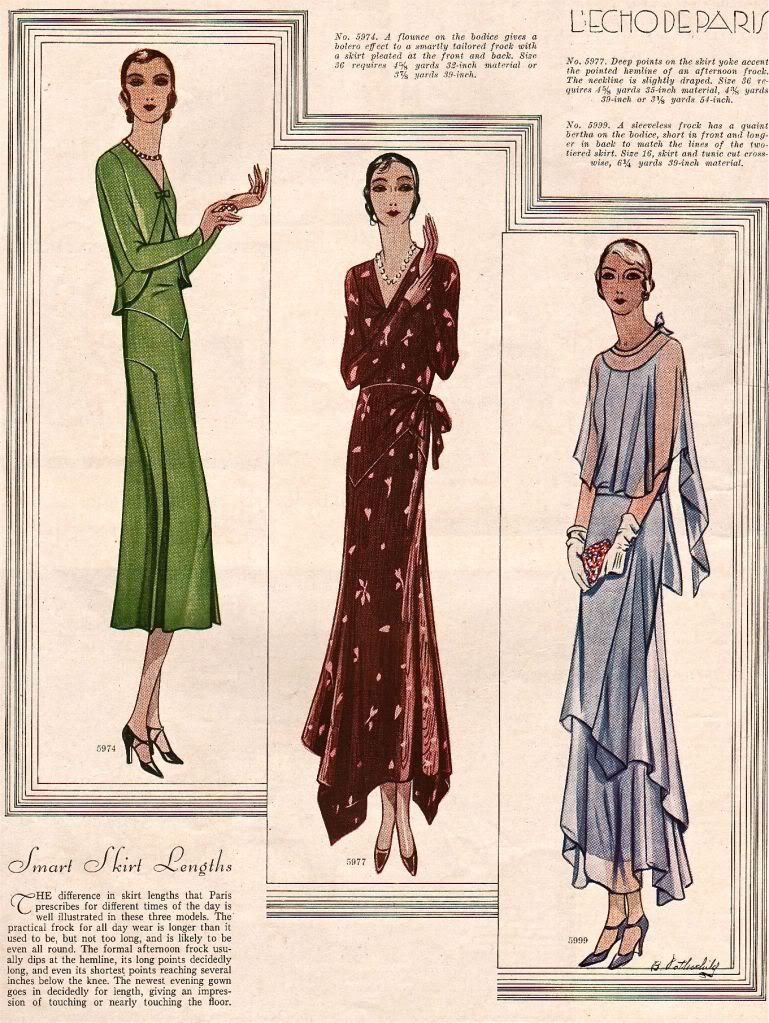
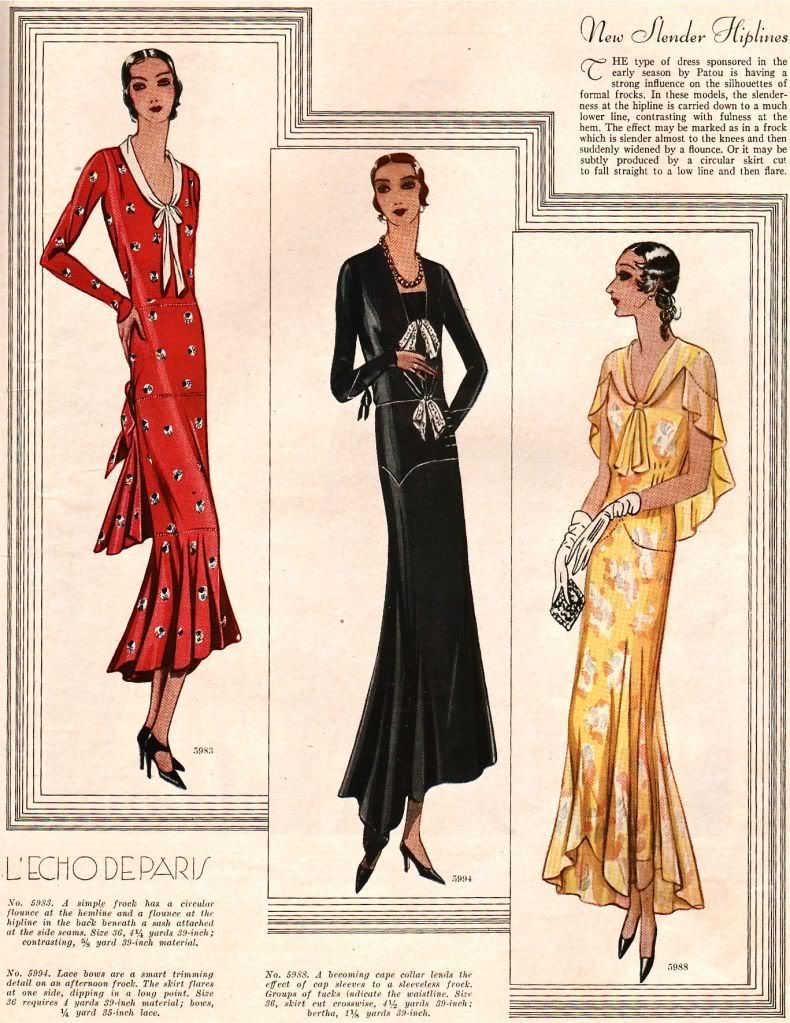
This 1930 issue of McCall's Magazine shows the latest styles from Paris. There are Smart Skirt Lengths and New Slender Hiplines.
These were patterns you bought to sew at home. How the 1930's sewing machines handled all this sheer draping fabrics cut on the bias reminds us just how good these seamstresses were.
These were patterns you bought to sew at home. How the 1930's sewing machines handled all this sheer draping fabrics cut on the bias reminds us just how good these seamstresses were.
"The difference in skirt lengths that Paris prescribes for different times of the day is well illustrated in these three models. The practical frock for all day wear is longer than it used to be, but not too long, and is likely to be even all round. The formal afternoon frock usually dips at the hemline, its long points decidedly long, and even its shortest points reaching several inches below the knee. The newest evening gown goes in decidedly for length, giving an impression of touching or nearly touching the floor."
"The type of dress sponsored in the early season by Patou is having a strong influence on the silhouettes of formal frocks. In these models, the slenderness at the hipline is carried down to a much lower line, contrasting with fulness at the hem. The effect may be marked as in a frock which is slender almost to the knees and then suddenly widened by a flounce. Or it may be subtly produced by a circular skirt cut to fall straight to a low line and then flare."
It Snowed!
Sunday, January 15, 2012
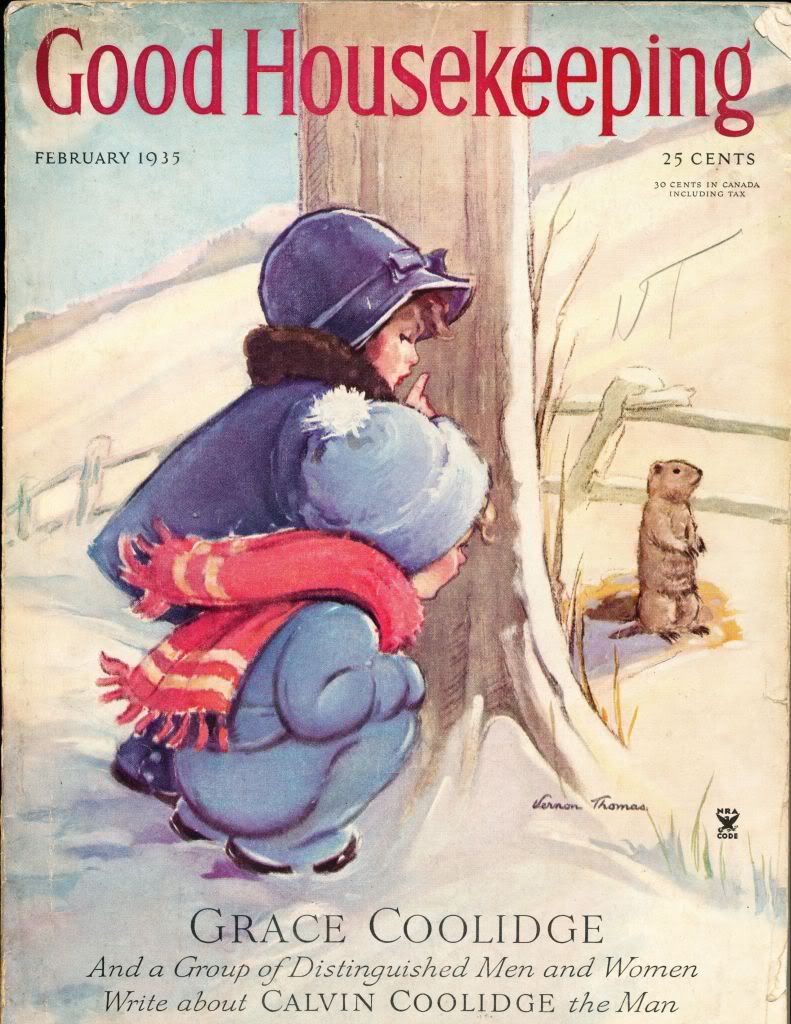
I'm home in Seattle and while it doesn't snow much here, the 2 year old granddaughter has talked about it for weeks. And finally we have snow! This Good Housekeeping cover by Vernon Thomas just looks like her and her little brother.
I hope you are all snug and warm!
I hope you are all snug and warm!
How To Choose The Right Foundation For You - More 1956 Underwear!
Wednesday, January 11, 2012
"Build Your Own Best Silhouette"
"Today foundation garments are designed for individual figure types and fitted as never before-all the way from lightweights for juniors to garments with built-in corrective features. They take account of high, waists, low waists, wide hips and narrow, bust sizes from AA to D. It's all done to make sure that you can find the garments that are exactly right for your figure."
"Three-way bra of white opaque nylon taffeta, with a frosting of lace at the bosom. About $6. Pretty and light, a step-in girdle of nylon power net with shaped center panel of lace over satin. About $11. Jantzen."
"KNOW YOUR OWN MEASUREMENTS

Choosing the right foundation can be a pretty perplexing job. You can save some of the salesgirl's time and your own if you go into the store knowing whether you are short- or long-waisted and what your bust, waist and hip measures are. This is the way to take your measurements: 1. Bust size. Hold a tape measure directly below the bust, then add 5 inches for your true size. Cup sizes for your bra may best be determined by the fitter. 2. Hip size. Make sure that you measure the fullest part of the hip. This is usually about 8 inches below the waist. 3. Waist size. Take a loose measure for accuracy. 4. Short waist? Long waist? Measure from directly below the bust to the waist to find out if you're short (3-4 inches), medium (5-6 inches) or long (6 1/2-7 inches). 5. Girdle length. A measure from waist to directly below the fullest part of the thigh will give you the right length. (This is important - a too-short girdle will ride up, a too-long girdle bind.) This measurement has nothing to do with your height.
WHEN YOU ARE FITTED
1. Move about in the garment and sit down-your flesh expands when you move or are seated. 2. Do not buy a size too small - this creates new bulges. 3. If your flesh is firm, you'll need less control than you will if it tends toward flabbiness. You'll find this out as the middle years come on. 4. A well-fitted girdle should control without causing a bulge or roll and without riding up.
WHAT YOU CAN EXPECT
Each type of foundation has a definite purpose. The all-in-one smooths away the bulges and gives a clean unbroken line that's especially good under slim dresses. High-waisted girdles paired off with long-line bras also give a smooth line and solve a special problem for women with full hips and small bust or large bust and average hip size (separates that suit your specific needs). For really firm control in the hip area there are lightweight garments with elastic panels at front, back and both sides. This eliminates the discomfort of heavy boning."


The richness and splendor of the East - 1956 Fashions
Sunday, January 8, 2012
This 1956 article from Woman's Home Companion is titled "A New Simplicity touches our lives today". They show the new influences in room decor and what you should be wearing in these rooms. 
"This new simplicity all around us comes from many sources-one of the most important is our new awareness of the restraint and beauty in Eastern design. Each generation since Marco Polo has rediscovered the Orient in its own way, drawing from it the ideas and qualities which suited its needs and which cave sparkle to its life. Our own generation is no exception. For us, the discovery has been vibrant colors on the one hand, serene monotones on the other. We reach out for the restraint, the simplicity of line, the lightness of scale-for everything, in fact, that brings a sense of space or that seems uncluttered to our extremely cluttered lives.

"This new simplicity all around us comes from many sources-one of the most important is our new awareness of the restraint and beauty in Eastern design. Each generation since Marco Polo has rediscovered the Orient in its own way, drawing from it the ideas and qualities which suited its needs and which cave sparkle to its life. Our own generation is no exception. For us, the discovery has been vibrant colors on the one hand, serene monotones on the other. We reach out for the restraint, the simplicity of line, the lightness of scale-for everything, in fact, that brings a sense of space or that seems uncluttered to our extremely cluttered lives.
The richness and splendor of the East, which have always appealed to earlier generations, are for us only implicit in the materials we choose. For instance, you may see an evening dress this season made of beautiful brocade but its effect usually depends entirely on its line-the material its only ornament.
How does all this affect you and me-in our homes, in our lives? Consciously or unconsciously, we find ourselves desiring certain things that stem from the East - light sliding screens to separate two rooms or throw them together, low light furniture, simple lighting fixtures, simple uninsistent backgrounds. In clothes, we admire the slim column-like line of a dress translated from the Chinese; in hairdos and makeup we try out an Oriental effect..."
"In the Eastern fashion, B. H. Wragge's beautiful interpretation of the slit Chinese robe, The tunic shirt of printed silk Honan shown here over a beige skirt of spun rayon, could also be worn over shorts."
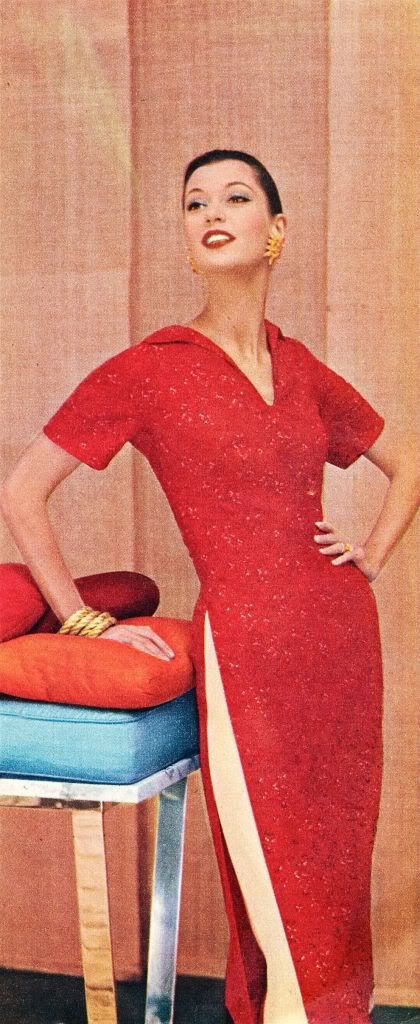
"Claire McCardell's modest jersey suit in the pencil-slim but graceful Chinese silhouette. The suit jacket is lined to match the turquoise pull-over blouse, fastened along Chinese lines with small buttons and fabric loops."
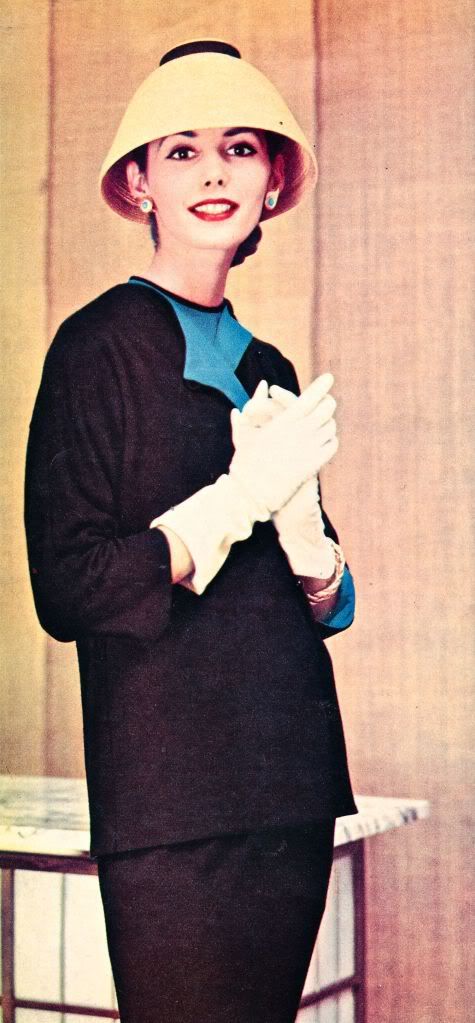
"A Chinese dress of Pink Poppy silk damask, imported by Dynasty of Hong Kong. In the classical tradition it is sleeveless, with the standing collar and side-slit skirt. Its functional lines focus attention on the elegant woven pattern of the fabric."

"Another striking example of this year's Chinese trend is this dress and jacket ensemble of orange silk linen. Note the jacket's stand-away collar and sloping shoulders. This illustrates how the Chinese influence can be adapted in an essentially Western fashion. From Talmack."

Protect your most Precious Treasure - Vanta Baby Garments - 1935
Saturday, January 7, 2012
So much here. A baby in a bubble, the mysterious Silva Lining, charming illustrations, 500 baby names and a career offer!
"Vanta Baby Garments - No Pins, No Buttons - made by specialists - in layette sizes they are steam sterilized and Cellophane-sealed - resist wash, wear, stretch and tear. The Silva Lining, obtainable in all layette sizes, is a smooth, super-absorbent fabric in cotton, wool with cotton, and silk and wool with cotton."
We also get "The Vanta Style Review" of sweet babes wearing these amazing garments. Then there is the pretty, but odd baby under glass illustration by Annie Benson Muller (she was a prolific illustrator, but I couldn't find out much about her life).
This picture and much of the text stresses how sanitary everything is. Which may have been a response to the Polio epidemics that frightened everyone (the most memorable was in 1916, but outbreaks continued through the 1950's).
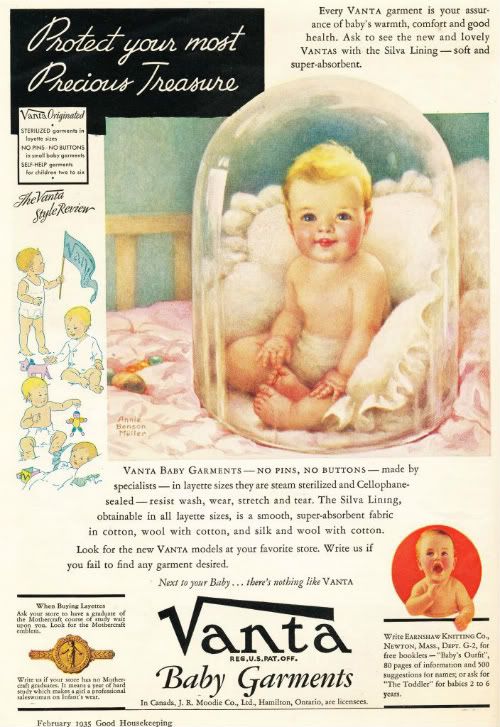
You also have an offer to write for a booklet -"Write EARNSHAW KNITTING CO.,NEWTON, MASS., DEPT. G-2, for free booklets - "Baby's Outfit", 80 pages of information and 500 suggestions for names; or ask for "The Toddler" for babies 2 to 6 years."
You can even become a Mothercraft graduate;
"When Buying Layettes - Ask your store to have a graduate of the Mothercraft course of study wait upon you. Look for the Mothercraft emblem. Write us if your store has no Mothercraft graduates. It means a year of hard study which makes a girl a professional saleswoman on Infant's wear."
"Next to your Baby...there's nothing like Vanta"
McCall's Magazine - 1964- Hail the Pale Look
Sunday, July 3, 2011
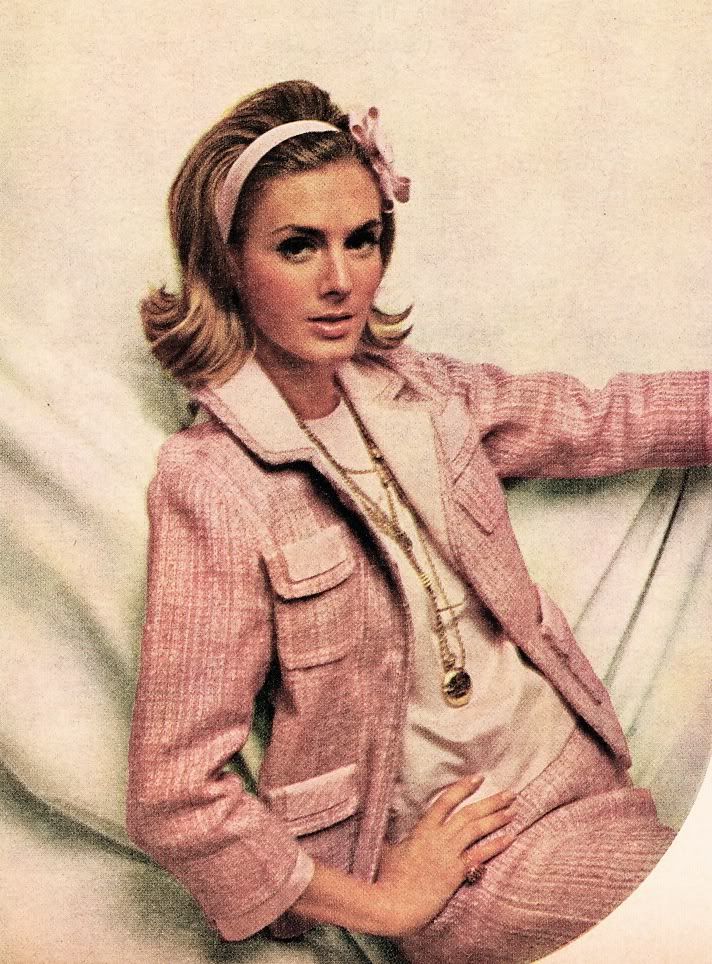
"The fashion picture this spring is painted in the prettiest and palest of watercolor shades, serenely soft-spoken pastels appropriately interpreted in lovely ladylike costumes. Look for deep-textured fabrics, effortless lines, and many delightful details derived from Chanel."
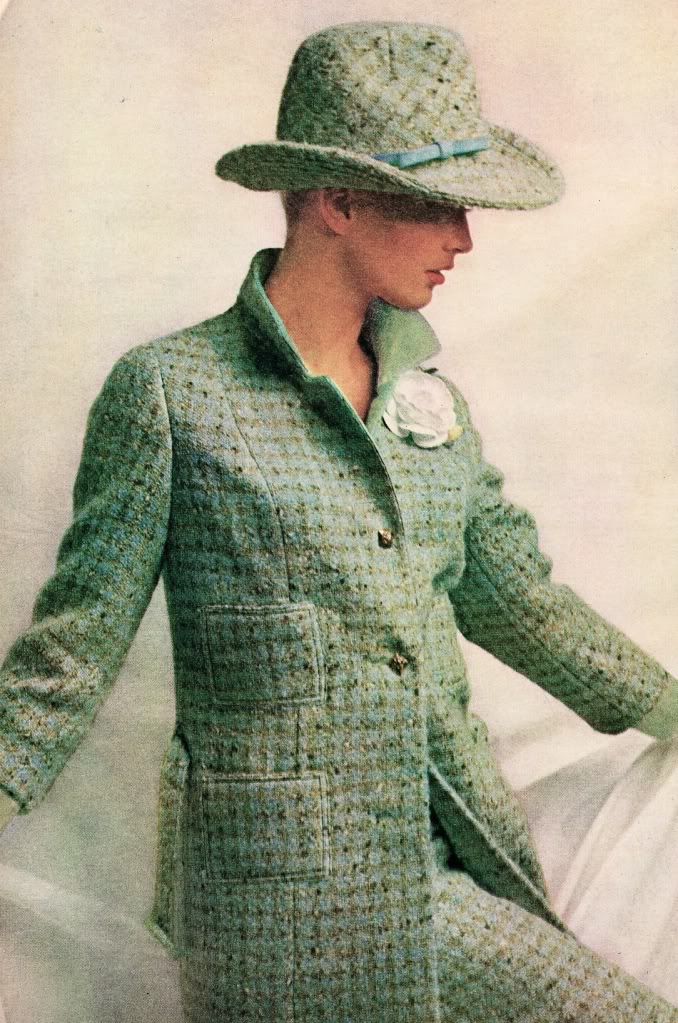
"Pale aqua, a subtle admixture of blue-and-green checked wool in a beautifully slender reefer-and-skirt costume. The coat has a casual elegance, with lion-head brass buttons reminiscent of Chanel, a notched collar faced in sage-green silk. About $110. Victor Joris for Cuddlecoat."
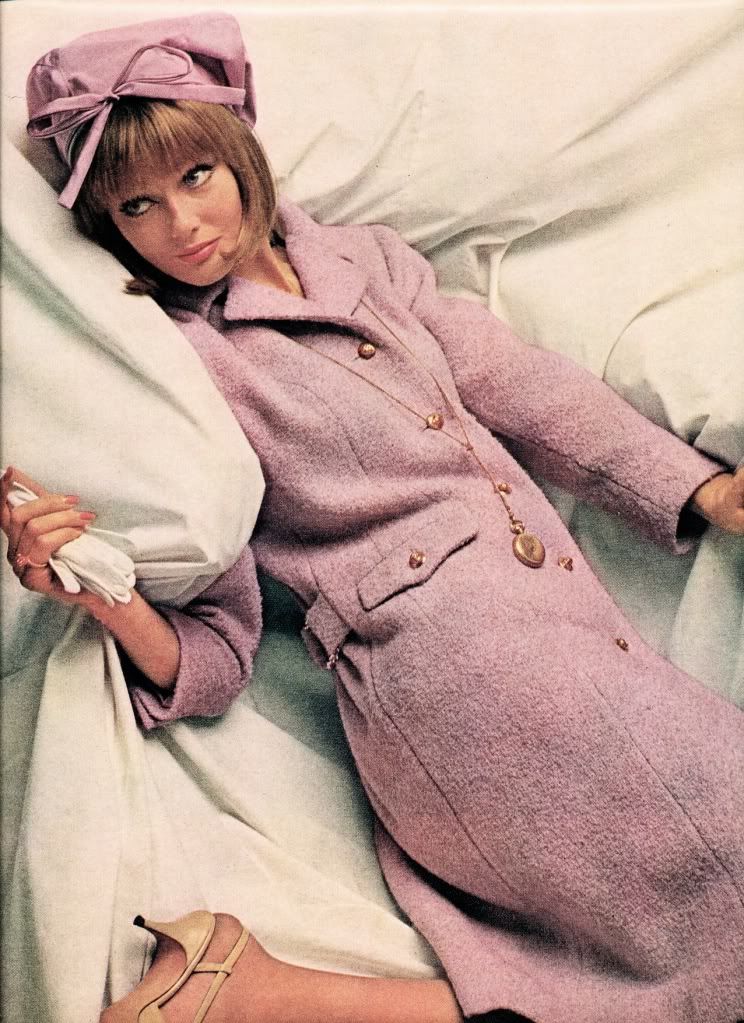
"Faint lilac, a shade delicate as perfumed spring air, in a superbly detailed wool-tweed coat. Note the pocket flaps slightly curved, a half belt joined with a Chanel-like chain. About $60. Faye Wagner for Dani Jrs. We show it accessorized with a lilac silk snood."
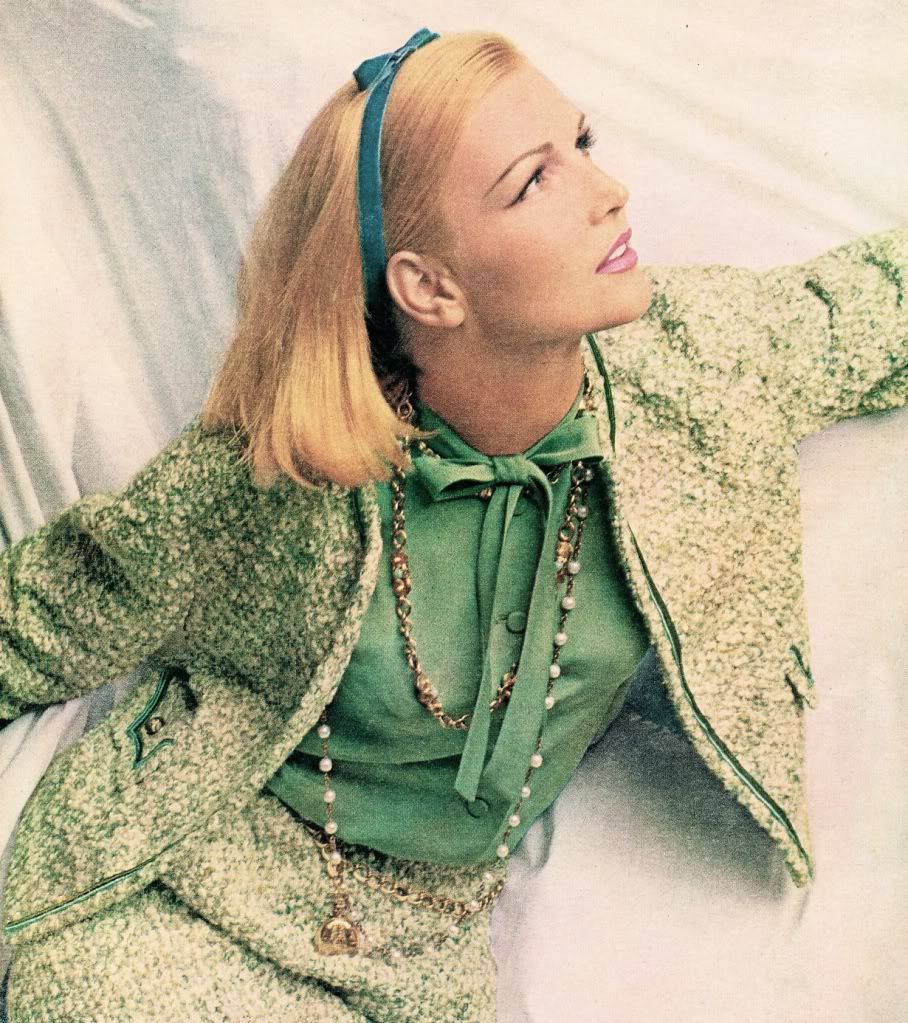
"Seafoam green, a frothy mixture of green, blue, and white, in a chenille like blend of wool and cotton. The suit jacket, in the Chanel tradition, is braid-trimmed and brass-buttoned; and the blouse is in this season's important new soft crepe. About $90. Stephan for Briarbrook."
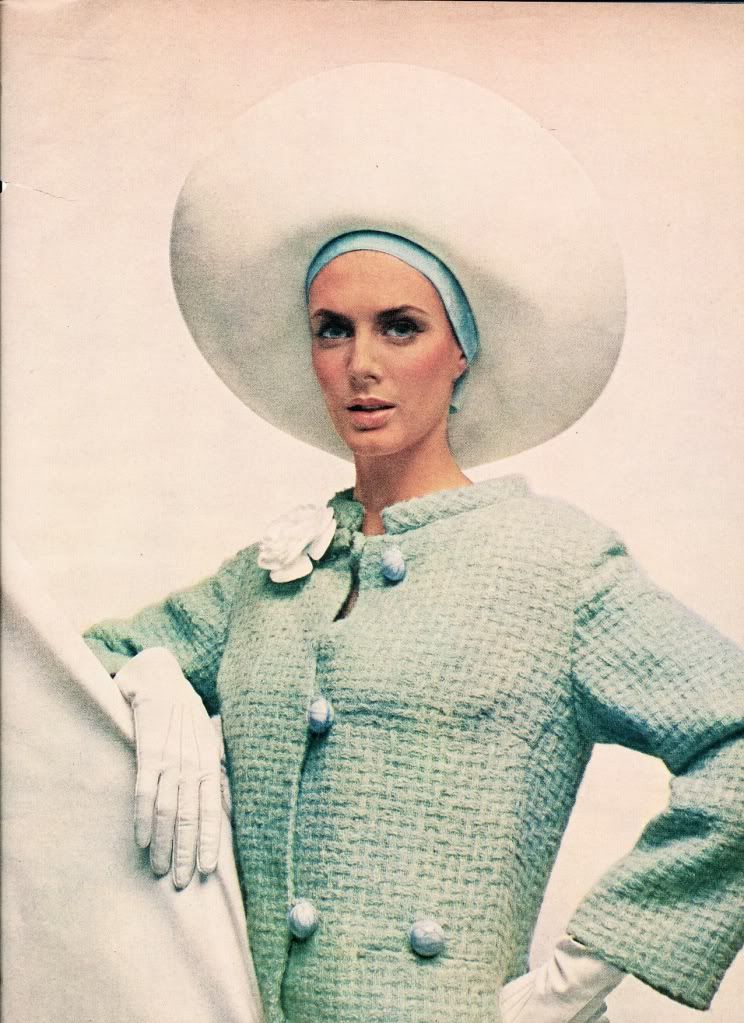
"Powder blue, in a deceptively fragile-looking white-flecked tweed with the delicacy and porousness of lace. The suit jacket has a mere suggestion of a stand-up collar and giant ball buttons; the eased skirt has two slash pockets at the hip line. About $100. Junior Sophisticates."
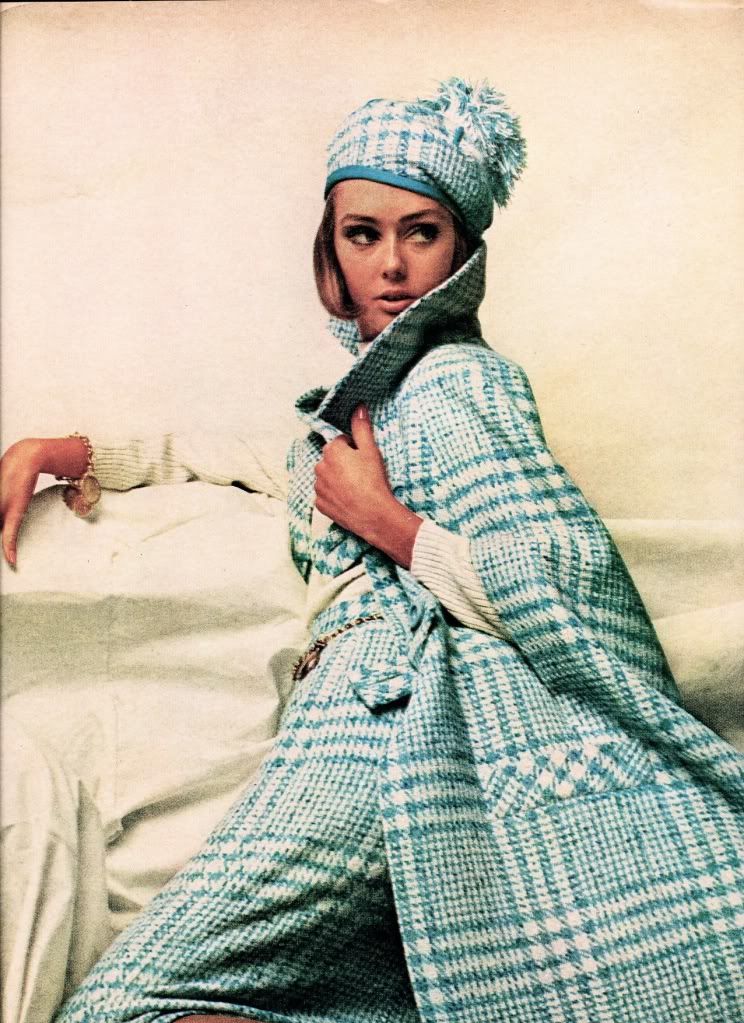
"Clear-sky blue, in a bold plaid on white, is fashioned into a dashing and dramatic cape costume. The cape, cut to full street length, has a big stand-up collar and fastens in front with outsize tabs of the same fabric. The matching skirt beneath is slim but easy. About $85. Modelia. The tasseled hat, by Adolfo."
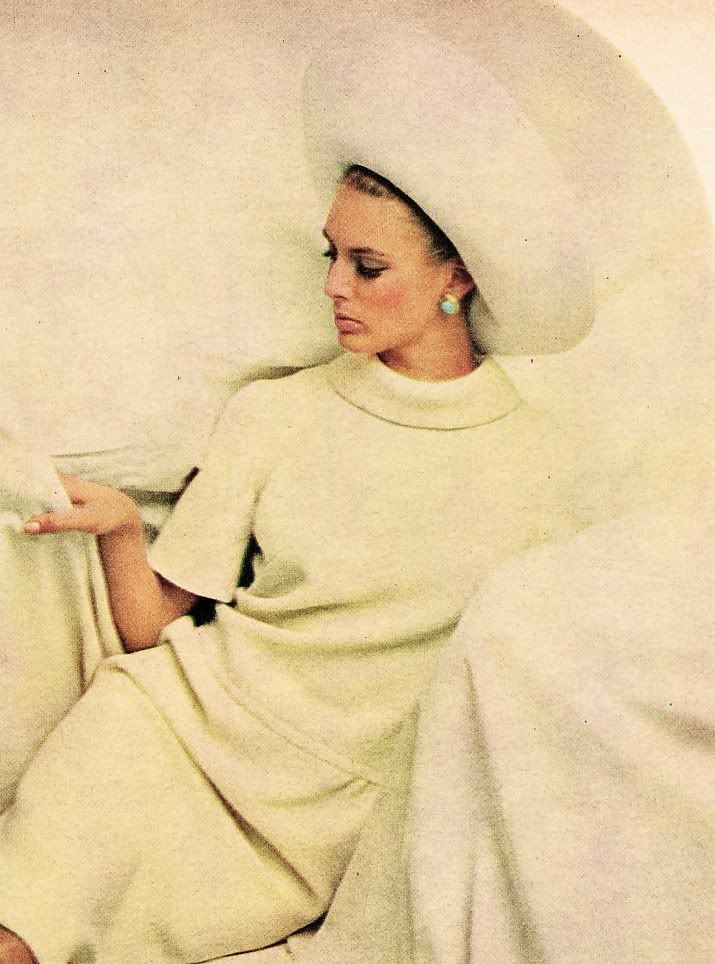
"Not quite white, but a rich creamy color, in an elegantly fluid afternoon dress, with a gently lowered waistline accented with heavy welt seaming, a high, cuffed neckline, and raglan sleeves. In lightweight textured wool. About $40. Stephan Ltd. Headline news: The big brim is back; ours is by Halston."
"Faint blush of pink, a marvelously muted shade in a delicate-looking three-piece costume. The jacket of lightweight tweed has accents of quilted pink silk inset in the collar, revers, and pocket flaps. The matching pink silk blouse is collarless. About $60. Frank Adams for Junior Accent."
McCall's Magazine - 1964- Beachwear
Saturday, July 2, 2011
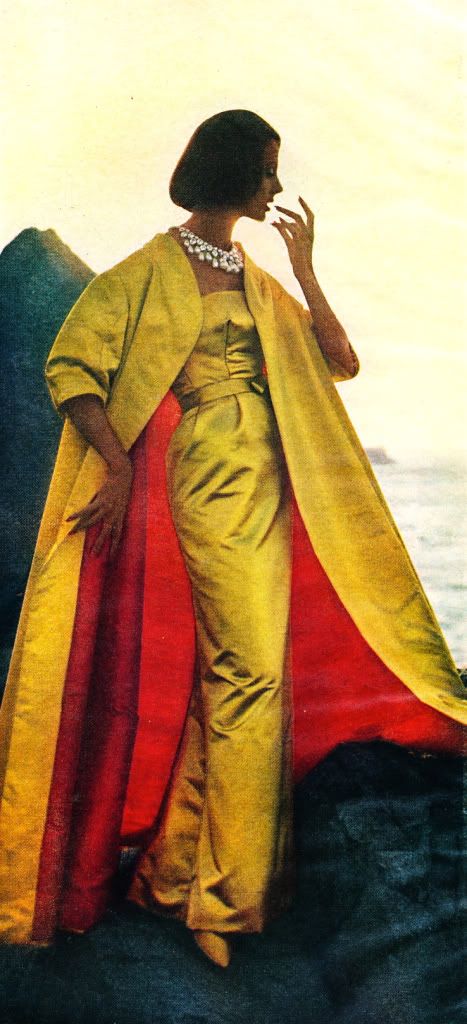
This is what I'll be wearing this weekend...what did you have planned?
McCall's Magazine- 1964 - Betsy McCall Writes from the Bahamas
Friday, July 1, 2011
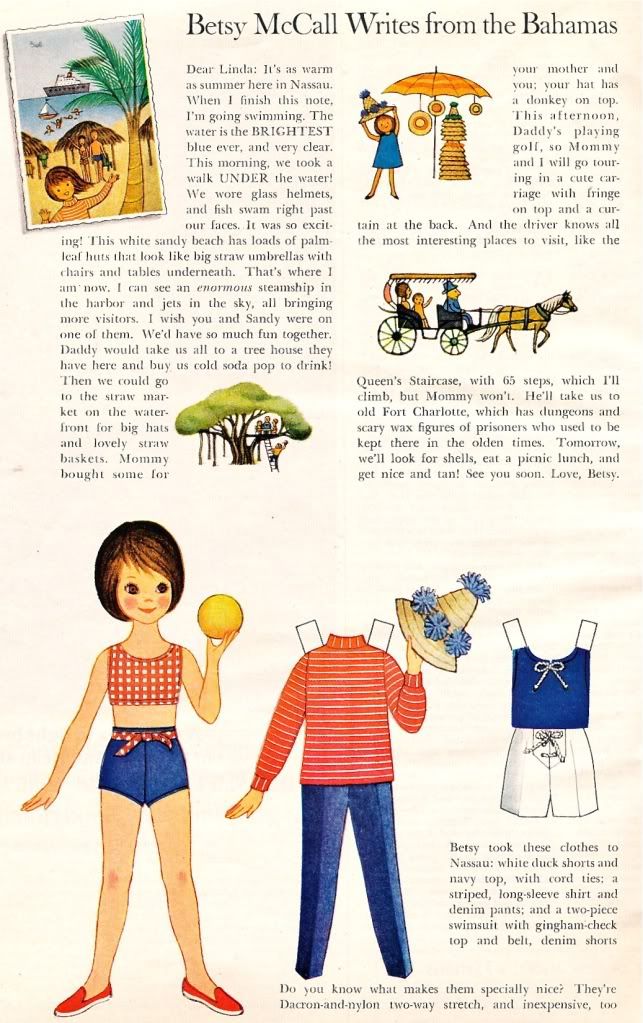
"Betsy took these clothes to Nassau..." You can click twice, print this out and go on vacation too!
McCall's Magazine -1964 - Patterns for Miss America
Thursday, June 30, 2011
"chosen to catch a gentleman's eye..."
NORTH
Lovely Donna Axum, of Arkansas, Miss America of 1964, is currently touring the country, modeling an Everfast wardrobe made from McCall's patterns. Here we show you four chosen to catch a gentleman's eye in every corner of the nation. Above: Donna wears a shirt dress in a brown-and-white,print, with crisp collar and cuffs. McCall's pattern 7183. Sewing tip: When interfacing collar and cuffs, trim edges of interfacing close to stitching line, to avoid bulk.

SOUTH
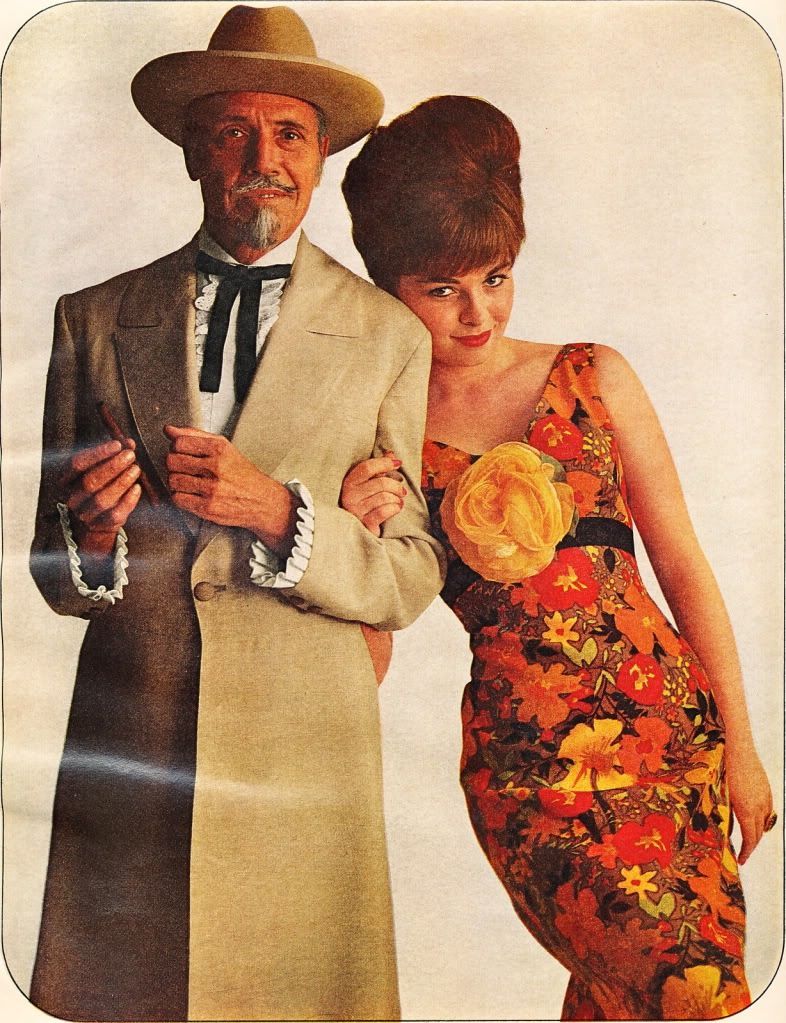
Miss America's knowledgeable choice for Magnolialand is a bold print interpreted in a lovely, long evening gown with, a low V neckline front and back. The raised waist is defined with black grosgrain ribbon garnished with a huge yellow flower. McCall's pattern 7195. Sewing tip: To add sweep to a long skirt, underline it with a lightweight shaping material. Use skirt pattern to cut dress fabric and underlining; then seam, treating the two fabrics as though they were one.
EAST
For the Ivy League or Madison Avenue circuit, Miss America's eye-catching orange-and-white print, in a blend of Kodel and cotton, has a becoming low, rounded neckline, big sleeves banded just below the elbow, wide waist-cinching self belt, and a full, full skirt. McCall's Easy-To-Sew pattern 7186. Sewing tip: To guarantee sure-to-hold, even gathers for a full skirt, wind bobbin with buttonhole twist or heavy-duty thread, and machine-baste in a double row at the waistline.

WEST
A marvelous murky stripe-and-print design in a dress with a low-waisted silhouette, very fashionable this season; a neckline high and square in front, dipping to a low V in back. McCall's pattern 7192. Sewing tip: To make the most effective and dramatic use of striped fabric, match stripes at seams, and plan fabric cutting so that the lower edge of the stripe falls at bottom of bodice and skirt. All fabrics in Miss America's wardrobe are by Everfast with Everglaze easy care.

Buy a Sewing Machine of the Present, and not one of the Past - Get A Singer - 1898
Friday, May 27, 2011
"Singer machines are so simple that a child can understand them; they are so strong that a bungler can hardly get them out of order"
As you read this substitute the words 'sewing machine' with 'computer' and consider what a technical miracle these were. Plus they "they never get the "fits" which try a woman's patience", who can say that about their computer?
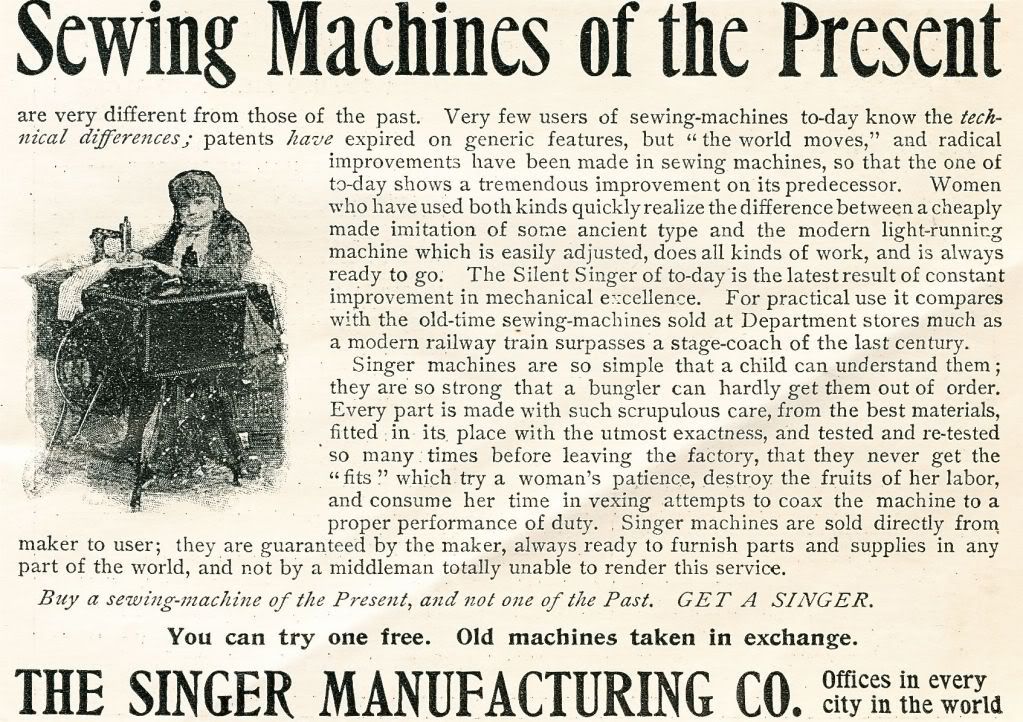
Sewing Machines of the present are very different from those of the past. Very few users of sewing-machines to-day know the technical differences; patents have expired on generic features, but " the world moves," and radical improvements have been made in sewing machines, so that the one of today shows a tremendous improvement on its predecessor. Women who have used both kinds quickly realize the difference between a cheaply made imitation of some ancient type and the modern light-running machine which is easily adjusted, does all kinds of work, and is always ready to go. The Silent Singer of to-day is the latest result of constant improvement in mechanical excellence. For practical use it compares with the old-time sewing-machines sold at Department stores much as a modern railway train surpasses a stage-coach of the last century.
Singer machines are so simple that a child can understand them; they are so strong that a bungler can hardly get them out of order. Every part is made with such scrupulous care, from the best materials fitted in its place with the utmost exactness, and tested and re-tested so many times before leaving the factory, that they never get the "fits" which try a woman's patience, destroy the fruits of her labor, and consume her time in vexing attempts to coax the machine to a proper performance of duty. Singer machines are sold directly from maker to user; they are guaranteed by the maker, always ready to furnish parts and supplies in any part of the world, and not by a middleman totally unable to render this service.
Tailor-Made Suits - $5 "When you wish the latest styles write to us"
Thursday, May 26, 2011
These models don't look very happy. In fact they look like elongated Barbie dolls. And their necks hurt from holding up those hats. I don't think fashion was very forgiving in 1898.

The New Idea Pattern Company - "Guaranteed as Perfect in Fit as any Dollar Pattern"
Wednesday, May 25, 2011
The New Idea Pattern Company existed from 1894-1920 and then merged with Butterick. (from Commercial Pattern Archive).
I have never come across a New Idea pattern...have any of you seen one?

Subscribe to:
Posts (Atom)